Following my Budget Traveller's Guide on Amsterdam, I am now going to share some travel tips on Prague.
Prague is the capital of the Czech Republic, and located right in the heart of Europe.
Therefore it is within easy reach from most starting points in Europe. How to get there leaves you a couple of choices: plane, train and bus are all available. The cheapest possibility by far is to go by bus. From Munich, there are daily bus lines available. Expressbus, the one we took, takes you there via Regensburg and Pilsen. The ride takes approximately 5 hours, and on board you get free wifi, plugs, coffee and even a film to watch! Be aware that during the weekend the bus can be very crowded. At the full price, a one way ride is 33€, but if you book in advance it can cost as little as 19€.
Accommodation in Prague is fairly easy to find. There are lots of cheap hostels available, and you can use Hostelworld.com for your search. We stayed at the Chili Hostel, which is located perfectly central in Praha 1, so everything is in walking distance. In a 8 bed dorm you can sleep for 4-6€ (it's more expensive on the weekend) per night. Unfortunately, our beds were very squeaky and with thin mattresses. It wasn't too bad, but something to keep in mind if you need a good rest. The 2 bathrooms are not ensuite, but have to be shared with 3 other dorms. There is a kitchen at your disposal, as well as wifi, computers and lockers. The staff and atmosphere were alright, even though it could have been a little more personal. All in all, the value for the money is extremely good as it's so inexpensive.
Now, let's talk about what to see and do in Prague!
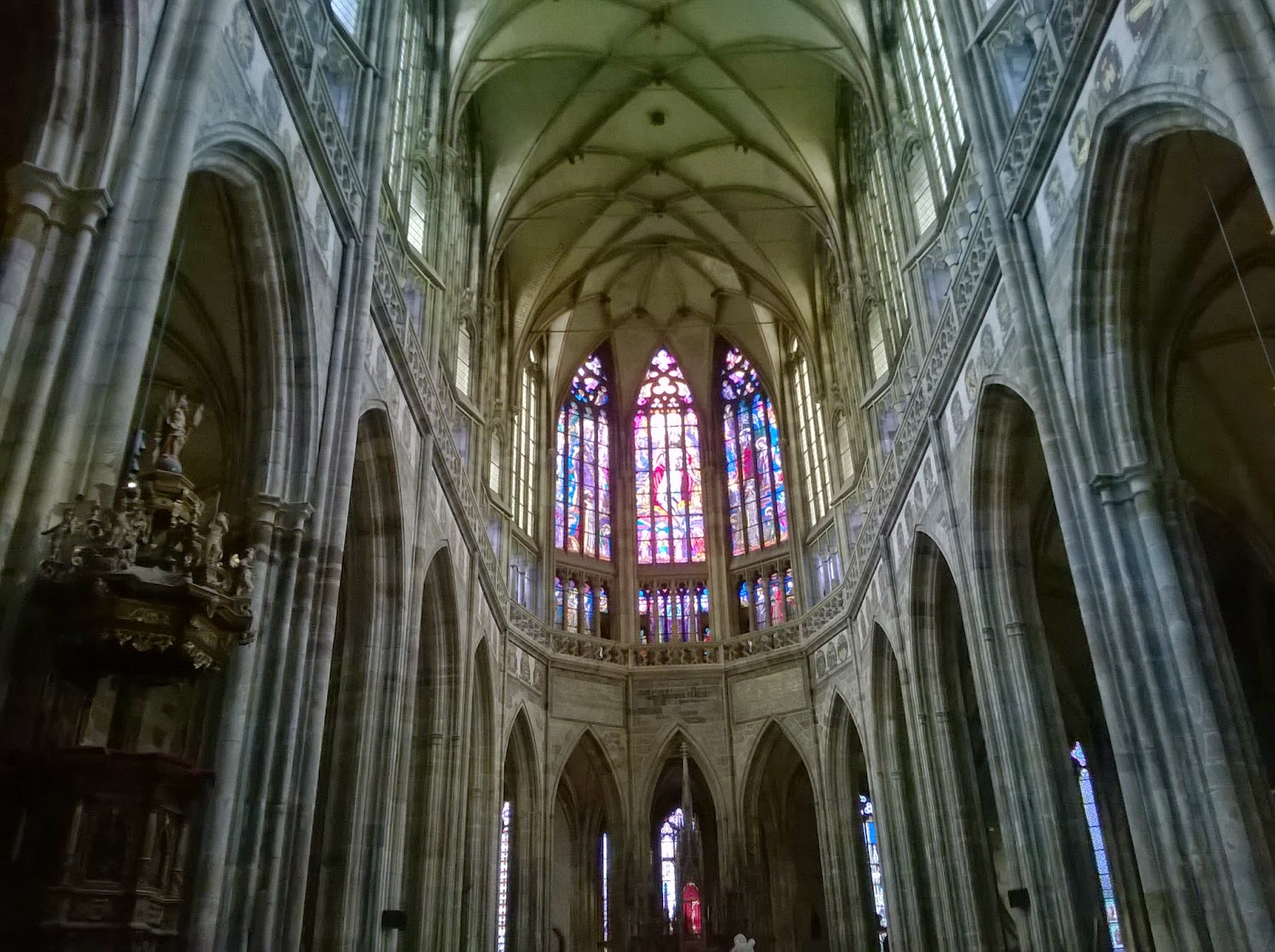
Prague's main attraction lies within its architecture. Both the Old Town District, and that of the castle have the most beautiful houses to see. Ranging from baroque to art nouveau, the houses all come in different styles and make it very hard to pick the prettiest. To take in this amazing part of the city, all you have to do is walk and look around - free and easy to do!
One special part of Prague's architecture is the Dancing House, or, as it's also called, Ginger & Fred. It was design by Frank O. Gehry and Milunic, and portrays a dancing couple, hence the nickname. Its deconstructivistic appearance makes for an interesting turn in the otherwise rather antique façades. Decide for yourself whether you find it fitting, but you can't deny it's something special!
One of Prague's most famous attractions is the Charles Bridge. It crosses the Vltava and connects the Old Town District with the Castle District. It is by far not the only bridge in Prague, but the prettiest and most famous. It is framed by huge sculptures on both sides that make it very nice and interesting to cross it. Also, you get a great view over the river and the historic town. Lots of people are always on the bridge, so try to go later at night when there aren't as many tourists.
The whole city is located on multiple hills. Prague also has lots of parks, and most of them are situated on said hills. That means you have a bit of climbing to do, but the great overviews you get from up there are well worth it. It really looks great when you can look down on it, so I highly recommend you pay some parks a visit.
The castle grounds and gardens are also free to visit. You can't go inside the castle without paying admission, but you can roam the area and have a look at everything nonetheless. And those castle grounds are really great to look at! They're very pretty, but somewhat classical and spacious. Keep in mind that the gardens aren't open until April, which was why we unfortunately couldn't see them.
If you want to go inside the castle, there are different combination tickets available. Their prices range from 10 to 13€, but if you're a student (or under 26), you can get in for half the price. And the tickets do not only include the castle itself, but two amazing churches on the property, and the Golden Lane, where the most famous little houses of Prague are located.
Museums are located all over the city, with typical ones like the national gallery, and more specific ones such as the Alfons Mucha Museum. Entrance fees at those places are relatively affordable and normally range from 7 to 12€.
A special aspect is the Jewish Museum. It's admission is quite high with 18€, but it includes the admission to all synagogues and the old Jewish cemetery. If you don't want to pay this fee, you can still have a look at all the synagogues from the outside, which is also what we did. And they are definitely worth a view! The Jewish Quarter is located in the heart of the old town.
The Czech currency is the Czech Koruna, or czk. One czk is approximately 0,03€, and 25czk make 1€. That's why their prices might sound extremely high, but really aren't. Paying 150czk for a dinner seems to be a lot, but it's just 6€. There are lots of ATMs at your disposal, which give you a great exchange rate wherever you're from. Also, euros are often accepted and converted at an sometimes even slightly better rate. It is advised, though, not to change at unofficial places.
When it comes to food, there are lots of places for you to try traditional Czech cuisine. Its traditional food consists of - not unlike to that of Bavaria - warm and somewhat heavy dishes such as goulash, pork or dumplings of all kinds. And to accompany the Czech food, beer is always a good choice!It might not be something for everyone, but it's definitely worth a try. The place we went to is called u medvíku. It is not only a restaurant, but a hotel and an old beer brewery. It has a very rustic interior, but also comfortable and the food was great. Prices are generally very low for a good meal, at around 5 to 8€. What is shown in the pictures is potato dumplings filled with pork cubes, served with red cabbage and sauerkraut. It was delicious.
Also important are the trdelníks. They're sweet pastry rolls that are rolled in sugar and cinnamon. You can get them pretty much everywhere all over the city, and they're very tasty!
Prague is also well-known for its great nightlife. From pubs to bars to clubs, everything is available. You can party in one of Europe's biggest clubs with 5 floors, or have a pint a bit off the touristic parts. Going out is especially popular because it's very inexpensive. You can already get a pint of beer for as a little as 1€!
As far as shopping is concerned, Prague offers the same chains other European countries also have. They are mixed with shops from all kinds of countries. You can shop at the British tesco, Costa or Marks&Spencer, the German dm or the Austrian Billa. Groceries are very cheap and therefore a simple meal costs close to nothing if you shop at supermarkets. All these different shops offer a huge variety, but at the same time mean that you're less likely to find typical Czech stores, at least along the main hotspots in the city. In contrast to the cheap supermarket prices, those at clothes chains and the likes are just the same as in any other country.
I can highly recommend to visit Prague. It's an amazing city that has lots to offer, and you can already enjoy it just from walking around. Prague is a very affordable city, which makes it great for all you budget travellers out there. What I would keep in mind is that Prague, or at least its city centre, isn't too big to require a very long stay. Especially if you're mainly looking for free stuff to do, you will run out of things to look at after a couple of days. But that also means that there's no need to hurry to see everything. You can take your time and enjoy your stay!
How do you guys like Prague?
xx, Misch
Showing posts with label recommendation. Show all posts
Wednesday, 25 March 2015
Friday, 27 February 2015
Kinsale: Ireland's Cutest Village
This is the next stop I would like to share with you from my road trip in the autumn. Kinsale was one of your first stops along the Irish coast line.
It is located in the south of Ireland, not far off Cork.
What makes Kinsale particularly special is how colourful the town is. All houses are painted in different, bright colours, and you won't find one boring one. Ones that have less colour on the façade are then decorated with lots of flowers or embellishments. This whole meticulous appearance leaves the impression of a very neat and well-kept town.
Paired with the numerous cobblestone walls, the colours in Kinsale really accentuate the town and make it a joy to walk through these streets.
Kinsale was literally one of the cutest places we visited. It is a small village, but built in a way that you can always turn around one corner and discover something totally new. Still, it is easy to walk everywhere, and it won't take you much time.
We passed so many special and individual stores: cafés, bookshop, a café in a bookshop, art supplies, kids' wear, jewellery, and anything else you can imagine. Looking at the windows of all these local shops made walking through the town centre even more interesting.
For lunch we then frequented one of the nice cafés we saw during our stroll through the centre. The Lemon Leaf Café made for a great experience, and that's why I'd love to point it out especially.
It is such a cute café, decorated nicely and the staff was incredibly friendly and hospitable. We felt really comfortable there, and had a lovely lunch.
Their sandwiches are really a great choice! With both wholegrain and white bread, you can have lots of different kinds of sandwiches. The one I had was wholegrain with avocado, lettuce, cheese, home-made mayo and ham. It was served with a side of sweet potato and beetroot crisps.
In addition to the great sandwiches, the selection of cakes is also worth a try. Me and my friends all opted for different ones, and weren't able to decide which one was the best. In the picture shown is a walnut coffee cake, but I can also really recommend the carrot cake, banoffee pie and cheesecake.
I have to say that I can definitely recommend you go check out Kinsale should you ever find yourselves in the area. It's not big, but it makes for such a pleasant afternoon stay that you can't miss it!
xx, Misch
Tags:
#4girls1bus,
Ireland,
personal,
recommendation,
travels
Thursday, 22 January 2015
Movie Review: The Imitation Game
Time for another movie review! This week, I saw The Imitation Game.
The Imitation Game is based on the real story of British mathematician Alan Turing, who is employed to decipher the code the Germans use for all major communication during the second world war.
It stars Benedict Cumberbatch as Alan Turing, and, as the female lead, Keira Knightley as Joan Clarke.
The movie begins with a narration from Benedict Cumberbatch that appears to be addressing all viewers directly. He urges to listen and watch closely, and pay attention. At the same time, we learn that we are in 1951, and the police are inquiring about a robbery in Alan Turing's home. Alan dismisses them, and they suspect him of keeping a secret.
After a jump back in time, Alan is shown at his job interview in Bletchley Park in 1939. He behaves unintentionally funny and inappropriate, but soon convinces the Commander that his advanced skills as a mathematician are much needed for the classified task, which is to decipher the German Enigma code. Alan is accepted into the team of five others, who have to work against time in order to help the Allies win the war. The combination possibilities for this code are of such a huge number that deciphering it appears to be impossible.
After a unsuccessful start, Alan is put in charge of the group and finds a new valuable team member in Joan. At the same time he conducts that to solve a machine's code, he will have to build his own machine, which he lovingly calls Christopher. He is not believed to succeed, and has to experience a couple of heavy set backs. All the while we learn through flashbacks and flash-forwards what happened in Alan's past and shortly after the war. While still working to crack the code, Alan and Joan become close friends and eventually agree to marry out of convenience. In the meantime Alan's homosexuality is revealed.
It takes a long time, but eventually they figure out how to decipher the German code. In the overwhelming feeling of victory Alan remains rational and explains they cannot simply prevent every German attack in the future. That would obviously lead to the Germans learning that their code had been cracked, which they could not let happen. From then on, the cracking of the code is being kept a secret, and which attacks to prevent and which not is decided on the basis of statistics and probability.
Even after their glorious success, Alan's homosexuality is discovered and he is made to undergo hormonal treatment, a fate Alan accepts rather than prison, because it means he can still continue his work. The treatment slowly devastates and wrecks him, and Alan commits suicide about a year after the beginning of his treatment.
The viewers are then informed about how Alan was one of many who had to undergo such procedures when homosexuality was still considered a crime, and at the same time how valuable Alan's work was not only for the ending of World War II, but also modern science, as his machine was one of the first models of modern computers.
During the whole movie, jumps in time are used to give the viewer a more complex and varied way of learning about everything that happens. They are very comprehensible and make the story more detailed.
Especially learning about Alan's past makes one understand his character traits a lot better. Early bullying as well as the discovery that he was different shaped his personality. The death of his close friend during his youth, and how rational and repressing he reacts is shown in a great way, and evokes a lot of sympathy for his character.
In addition to that, scenes of actual war recordings are included in the movie to give a lot of authenticity. It is easy to forget what they are actually dealing with when simply being secluded at Bletchley Park, but those little scenes make it a lot more real and dreadful.
What definitely has to be kept in mind with this movie is that it dramatises historic events, and does not always stay true to the definite facts. Important parts of history are being omitted, which is very understandable with the in some ways limited possibilities of a movie and the criteria the story has to match. Nonetheless, it is based on very real events.
What I find shocking is that in all the ways World War II is being taught at school, Alan Turing is mentioned almost never. The tragic story that was his life is something that should not be neglected when talking about the events of the war in my opinion, as he influenced not only that, but many other areas as well.
Some critical voices find this movie to be too patriotic, but I definitely disagree with that. Of course, Alan working for his country during the war and the victory he achieves for them can't help but be patriotic in a way. But in the end, it is that same country that turns against him and ultimately forces him into suicide. This being shown definitely makes you reconsider the patriotic aspect.
Benedict Cumberbatch plays Alan Turing as a very nuanced person, who is brilliant in his topic of expertise, but then lacks personal skills in other ways. A lot of scenes are full of comedy caused by his ignorance and oblivious behaviour towards other people. His arrogance doesn't make you like him any less, though. On the contrary, he is this extremely precious person whom you can't help but sympathise with. His life story is incredibly tragic, which is very well portrayed by the movie.
Joan, as depicted by Keira Knightley, is also a very interesting character. She is very strong and does not dumb herself down at all. In an all-male environment she proves herself to be worthy of the position, and does not let anyone tell her differently, even in a time when feminism was far from developed. Her character develops a lot during the movie, and leaves her being a person who knows what she wants and who is not afraid to put herself first.
Both actors have received an Oscar nomination for their work in this movie, in addition to six other categories the whole film is nominated for, including best picture, best directing and best screenplay. These nominations and in any case an actual win are highly deserved in my opinion. The movie had everything that a very good one needs. It's very moving and touching, is acted superbly and tells a inspiring and important story. People should know about his life and the way he was treated, it's a story to be spread, and luckily that's exactly what the movie does.
Has anyone of you seen The Imitation Game?
xx, Misch
The Imitation Game is based on the real story of British mathematician Alan Turing, who is employed to decipher the code the Germans use for all major communication during the second world war.
It stars Benedict Cumberbatch as Alan Turing, and, as the female lead, Keira Knightley as Joan Clarke.
The movie begins with a narration from Benedict Cumberbatch that appears to be addressing all viewers directly. He urges to listen and watch closely, and pay attention. At the same time, we learn that we are in 1951, and the police are inquiring about a robbery in Alan Turing's home. Alan dismisses them, and they suspect him of keeping a secret.
After a jump back in time, Alan is shown at his job interview in Bletchley Park in 1939. He behaves unintentionally funny and inappropriate, but soon convinces the Commander that his advanced skills as a mathematician are much needed for the classified task, which is to decipher the German Enigma code. Alan is accepted into the team of five others, who have to work against time in order to help the Allies win the war. The combination possibilities for this code are of such a huge number that deciphering it appears to be impossible.
After a unsuccessful start, Alan is put in charge of the group and finds a new valuable team member in Joan. At the same time he conducts that to solve a machine's code, he will have to build his own machine, which he lovingly calls Christopher. He is not believed to succeed, and has to experience a couple of heavy set backs. All the while we learn through flashbacks and flash-forwards what happened in Alan's past and shortly after the war. While still working to crack the code, Alan and Joan become close friends and eventually agree to marry out of convenience. In the meantime Alan's homosexuality is revealed.
It takes a long time, but eventually they figure out how to decipher the German code. In the overwhelming feeling of victory Alan remains rational and explains they cannot simply prevent every German attack in the future. That would obviously lead to the Germans learning that their code had been cracked, which they could not let happen. From then on, the cracking of the code is being kept a secret, and which attacks to prevent and which not is decided on the basis of statistics and probability.
Even after their glorious success, Alan's homosexuality is discovered and he is made to undergo hormonal treatment, a fate Alan accepts rather than prison, because it means he can still continue his work. The treatment slowly devastates and wrecks him, and Alan commits suicide about a year after the beginning of his treatment.
The viewers are then informed about how Alan was one of many who had to undergo such procedures when homosexuality was still considered a crime, and at the same time how valuable Alan's work was not only for the ending of World War II, but also modern science, as his machine was one of the first models of modern computers.
During the whole movie, jumps in time are used to give the viewer a more complex and varied way of learning about everything that happens. They are very comprehensible and make the story more detailed.
Especially learning about Alan's past makes one understand his character traits a lot better. Early bullying as well as the discovery that he was different shaped his personality. The death of his close friend during his youth, and how rational and repressing he reacts is shown in a great way, and evokes a lot of sympathy for his character.
In addition to that, scenes of actual war recordings are included in the movie to give a lot of authenticity. It is easy to forget what they are actually dealing with when simply being secluded at Bletchley Park, but those little scenes make it a lot more real and dreadful.
What definitely has to be kept in mind with this movie is that it dramatises historic events, and does not always stay true to the definite facts. Important parts of history are being omitted, which is very understandable with the in some ways limited possibilities of a movie and the criteria the story has to match. Nonetheless, it is based on very real events.
What I find shocking is that in all the ways World War II is being taught at school, Alan Turing is mentioned almost never. The tragic story that was his life is something that should not be neglected when talking about the events of the war in my opinion, as he influenced not only that, but many other areas as well.
Some critical voices find this movie to be too patriotic, but I definitely disagree with that. Of course, Alan working for his country during the war and the victory he achieves for them can't help but be patriotic in a way. But in the end, it is that same country that turns against him and ultimately forces him into suicide. This being shown definitely makes you reconsider the patriotic aspect.
I was incredibly touched by the movie, and it made me cry at several points. On the other hand, it also made me laugh quite often. The emotions varied all film long, and were not one-sided at all. A whole spectrum of feelings is shown and at the same time evoked in the audience.
The film captures your attention and makes you forget everything else around you. It would have taken a lot for me to take my eyes off the screen for even a moment, that's how captured I was.
It's not only moving but also full of suspense. The race against the time, their need to figure out the code; it's very thrilling and exciting.
The tragedy of Alan Turing's story is told in such a heart-wrenching way that it quite literally makes you rejoice as he does, and also ache as he does. It is very inspiring and makes you think. The whole audience was deeply impressed by the story and the portrayal, and at the end, everyone even clapped. It was the first time that I ever experienced something like this, the audience clapping after a movie, and I walked out of there, and felt ready to cry more.
Benedict Cumberbatch plays Alan Turing as a very nuanced person, who is brilliant in his topic of expertise, but then lacks personal skills in other ways. A lot of scenes are full of comedy caused by his ignorance and oblivious behaviour towards other people. His arrogance doesn't make you like him any less, though. On the contrary, he is this extremely precious person whom you can't help but sympathise with. His life story is incredibly tragic, which is very well portrayed by the movie.
Joan, as depicted by Keira Knightley, is also a very interesting character. She is very strong and does not dumb herself down at all. In an all-male environment she proves herself to be worthy of the position, and does not let anyone tell her differently, even in a time when feminism was far from developed. Her character develops a lot during the movie, and leaves her being a person who knows what she wants and who is not afraid to put herself first.
Both actors have received an Oscar nomination for their work in this movie, in addition to six other categories the whole film is nominated for, including best picture, best directing and best screenplay. These nominations and in any case an actual win are highly deserved in my opinion. The movie had everything that a very good one needs. It's very moving and touching, is acted superbly and tells a inspiring and important story. People should know about his life and the way he was treated, it's a story to be spread, and luckily that's exactly what the movie does.
Has anyone of you seen The Imitation Game?
xx, Misch
Thursday, 15 January 2015
Movie Review: The Theory of Everything
Here's my review of the latest movie I've seen: The Theory of Everything.
The Theory of Everything is a dramatic biopic portraying the life of Stephen Hawking and his relationship with his first wife, Jane Wilde Hawking. It is based on the book "Travelling to Infinity - My Life With Stephen" which Jane has written.
It stars Eddie Redmayne as Stephen Hawking and Felicity Jones as Jane Hawking.
The movie begins with the first encounter of Stephen and Jane at Cambridge, and shows how their relationship evolves while Stephen is trying to find a topic for his doctoral study. Soon he learns about his illness ALS, or motor neurone disease, which gradually makes him lose his physical control over his body, and his ability to move and speak. In spite of Stephen trying to push her away, Jane stays with him, even though Stephen is predicted a life expectancy of no more than 2 more years. The couple gets closer and then marries. Stephen exceeds all expectations by living way longer than the predicted 2 years, but still his illness progresses and his condition worsens. All the while Jane supports him and gives up every personal freedom for him and later also their children. Even though she does not show it to Stephen, Jane slowly loses her spirit at this self-sacrificing duty. In the meantime Stephen continues his works as a physicist, and makes a name for himself in the world with his theories. Their relationship evolves further and they start to somewhat disunite, especially when Jonathan comes into their lives. He proves himself to be a great help for the family, but at the same time starts to develop feelings for Jane. Stephen gets help after a seizure that effectively made him lose his speech, and learns to communicate with the help of a computer-generated speech programme. The end of the movie shows how, even after their divorce, Jane and Stephen are still very fond of each other and are of huge importance in each others' lives.
The movie, being based on the true story of the Hawkings, is made in a wholly comprehensible way, which makes it simple for the viewers to relate to the characters and their tragic story. It is incredibly moving and makes you anticipate eagerly the continuation of the story.
It covers every possible feeling, from the joy of the young love and the triumph of success all the way to the desperation of failure and helplessness. Some parts are utterly sad, and can definitely make you cry. But it's not a sad movie, sadness is just one aspect shown in it. It's full of excitement and sorrow at the same time. And that is one factor that makes it such a special movie, because it does not portray this story in a one-sided way at all.
The cast of the film does a wonderful job at making this movie as relatable and intense as it is.
Eddie Redmayne is outstanding, his portrayal of Stephen Hawking is unprecedented and utterly brilliant. He manages to depict him in a very realistic way that never feels overdone or unnatural. He adapts the peculiarities of the motor neurone disease in such a manner that makes them understandable and evokes the empathy of the viewers.
Felicity Jones gives an equally stunning performance as Jane Hawking, and perfectly conveys the strength of her character. She expresses the feeling of wanting to help, but at the same time reaching her limits and possibilities, and the subtle variations between those two sides, in a wonderful way.
Both leading roles have been nominated for an Oscar, which is very much deserved in my opinion.
In conclusion, The Theory of Everything is an extraordinary movie full of emotions of all kinds. It is very touching and definitely worth a view. Personally, I enjoyed it very much and at the same time it gave me lots of reasons to contemplate. It touched me, and made me reflect, which is exactly what a good movie should do.
Has anyone of you seen The Theory of Everything? Did you like it?
xx, Misch
Tuesday, 13 January 2015
Cliffs of Moher: a must-see in Ireland
This stop was one of the most exciting ones we had in Ireland: the Cliffs of Moher.
These cliffs are a super fascinating scenery located directly on the western coast line of Ireland, about halfway between Limerick and Galway. If you follow the Wild Atlantic Way, you will directly drive along them.
When visiting the Cliffs of Moher, you can explore a little exhibition about the cliffs and all kinds of facts in the Exhibition Centre. And then, outside, there's a long way to walk along the cliffs. Starting at the exhibition centre, you can walk quite a couple of kilometres both to the left and the right.
If you prefer to stay safe and a bit away from the actual cliffs, it is better to choose the way to the left, where you have more of an actual path.
To the right, the fixed path ends relatively soon, but you can proceed on a way over some fields. There are no boundaries stopping you from stepping all the way to the edge. This is way more fun, if you like a bit of a risk, but also more dangerous.
We walked in both directions, and they were equally beautiful. The right side was more exciting, though.
You can walk directly along the edge at approximately 200 metres above the sea. The feeling you get up there is indescribable. It's frightening but at the same time very exciting. You're full of adrenaline when you look down, because it really wouldn't take much to fall down.
We sat down at one point, feet dangling in the air, and it was such a strange but good feeling. I was most certainly scared, but I am so glad that I did it and made myself sit down.
The Cliffs of Moher are very popular, not only for their beauty but also because they were a shooting location for Harry Potter. The scene in Harry Potter and the Half-blood Prince, where Harry and Dumbledore are standing on a cliff in the sea, right before they enter Tom Riddle's cave where he hid the amulet horcrux, was filmed there.
You can see the platform on which they stood in the water, but can also tell that in the movie a lot of CGI and editing was used. It's exciting nonetheless!
Even though it was a rainy and windy day when we were there, we spent hours walking along the cliffs, taking pictures and enjoying it as best as we could. We are deeply impressed by the scenery, and I would most certainly go back.
I highly recommend this experience, and hope that you too will check it out, should you ever find yourselves in that area. But please be safe and don't risk too much by stepping too close to the edge!
xx, Misch
These cliffs are a super fascinating scenery located directly on the western coast line of Ireland, about halfway between Limerick and Galway. If you follow the Wild Atlantic Way, you will directly drive along them.
When visiting the Cliffs of Moher, you can explore a little exhibition about the cliffs and all kinds of facts in the Exhibition Centre. And then, outside, there's a long way to walk along the cliffs. Starting at the exhibition centre, you can walk quite a couple of kilometres both to the left and the right.
If you prefer to stay safe and a bit away from the actual cliffs, it is better to choose the way to the left, where you have more of an actual path.
To the right, the fixed path ends relatively soon, but you can proceed on a way over some fields. There are no boundaries stopping you from stepping all the way to the edge. This is way more fun, if you like a bit of a risk, but also more dangerous.
We walked in both directions, and they were equally beautiful. The right side was more exciting, though.
You can walk directly along the edge at approximately 200 metres above the sea. The feeling you get up there is indescribable. It's frightening but at the same time very exciting. You're full of adrenaline when you look down, because it really wouldn't take much to fall down.
We sat down at one point, feet dangling in the air, and it was such a strange but good feeling. I was most certainly scared, but I am so glad that I did it and made myself sit down.
The Cliffs of Moher are very popular, not only for their beauty but also because they were a shooting location for Harry Potter. The scene in Harry Potter and the Half-blood Prince, where Harry and Dumbledore are standing on a cliff in the sea, right before they enter Tom Riddle's cave where he hid the amulet horcrux, was filmed there.
You can see the platform on which they stood in the water, but can also tell that in the movie a lot of CGI and editing was used. It's exciting nonetheless!
Even though it was a rainy and windy day when we were there, we spent hours walking along the cliffs, taking pictures and enjoying it as best as we could. We are deeply impressed by the scenery, and I would most certainly go back.
I highly recommend this experience, and hope that you too will check it out, should you ever find yourselves in that area. But please be safe and don't risk too much by stepping too close to the edge!
xx, Misch
Tags:
#4girls1bus,
harry_potter,
Ireland,
personal,
recommendation,
travels
Saturday, 20 December 2014
London: Camellia's Tea House
I've finally decided on the way I want to talk about the great experiences I made during my road trip, and it's going to be totally at random. Whatever I feel like, city, shop, activity, it doesn't matter.
I hope you don't mind I chose that way of talking about it all, but any other way would take a great part of the fun out of it, and I really want to avoid that.
What I want to share with you guys today is a great experience I had in London, which was actually the very last stop of our trip. I loved the city, and one afternoon I went out for tea with two of my friends, as one does in England.
The place we went to is called Camellia's Tea House, and I liked it so much that wanted to recommend it to you, should you ever find yourselves in London.
Camellia's Tea House can be found on the second floor of a tiny version of a food & shopping centre, called the Kingly Court. It is located in Carnaby Street, which is in Soho.
Inside the Tea House you can choose from a great selection of things. They have many different kinds of cakes, pastries and biscuits. What I loved about the tea selection is that they have it put up in a shelf, and before ordering you can go and smell the tea to make your choice easier. Which it doesn't really do, though, given that the teas to choose from are so numerous.
In the end I went for a cream tea with chocolate tea, in case you were interested. They make really good scones, served with jam and clotted cream.
On thing I really appreciated about the location was how lovely it looked. It was decorated nicely, and had this great view down on the court, which itself was decorated by tons of fairy lights. It's not very kitschy, which I liked a lot, only very appealing.
I also loved how there didn't seem to be only tourists in there. It was not one of those places crammed with people, but very calm and nice.
Considering being in central London, it was fairly reasonably priced, with 7,95£ for a cream tea. That's of course not cheap, but kind of what you have to expect when being in London. It is a very expensive city after all!
I can definitely recommend this Tea House! Maybe you'd like to check it out during your next trip to London, or some other shop in the Kingly Court.
Has anyone of you ever been there?
xx, Misch
I hope you don't mind I chose that way of talking about it all, but any other way would take a great part of the fun out of it, and I really want to avoid that.
What I want to share with you guys today is a great experience I had in London, which was actually the very last stop of our trip. I loved the city, and one afternoon I went out for tea with two of my friends, as one does in England.
The place we went to is called Camellia's Tea House, and I liked it so much that wanted to recommend it to you, should you ever find yourselves in London.
Camellia's Tea House can be found on the second floor of a tiny version of a food & shopping centre, called the Kingly Court. It is located in Carnaby Street, which is in Soho.
Inside the Tea House you can choose from a great selection of things. They have many different kinds of cakes, pastries and biscuits. What I loved about the tea selection is that they have it put up in a shelf, and before ordering you can go and smell the tea to make your choice easier. Which it doesn't really do, though, given that the teas to choose from are so numerous.
In the end I went for a cream tea with chocolate tea, in case you were interested. They make really good scones, served with jam and clotted cream.
I also loved how there didn't seem to be only tourists in there. It was not one of those places crammed with people, but very calm and nice.
Considering being in central London, it was fairly reasonably priced, with 7,95£ for a cream tea. That's of course not cheap, but kind of what you have to expect when being in London. It is a very expensive city after all!
I can definitely recommend this Tea House! Maybe you'd like to check it out during your next trip to London, or some other shop in the Kingly Court.
Has anyone of you ever been there?
xx, Misch
Tags:
#4girls1bus,
food,
london,
recommendation,
travels
Subscribe to:
Posts (Atom)